The System Isn’t Breaking. It’s Learning to Absorb You.

Millions marched. The state scrolled past.
Sunday, October 19
Stories from the week that demand action, not just attention.
By Johan
Professor of Behavioral Economics & Applied Cognitive Theory
Former Foreign Service Officer
Share this and get others to join the conversation
Subscribe for clarity
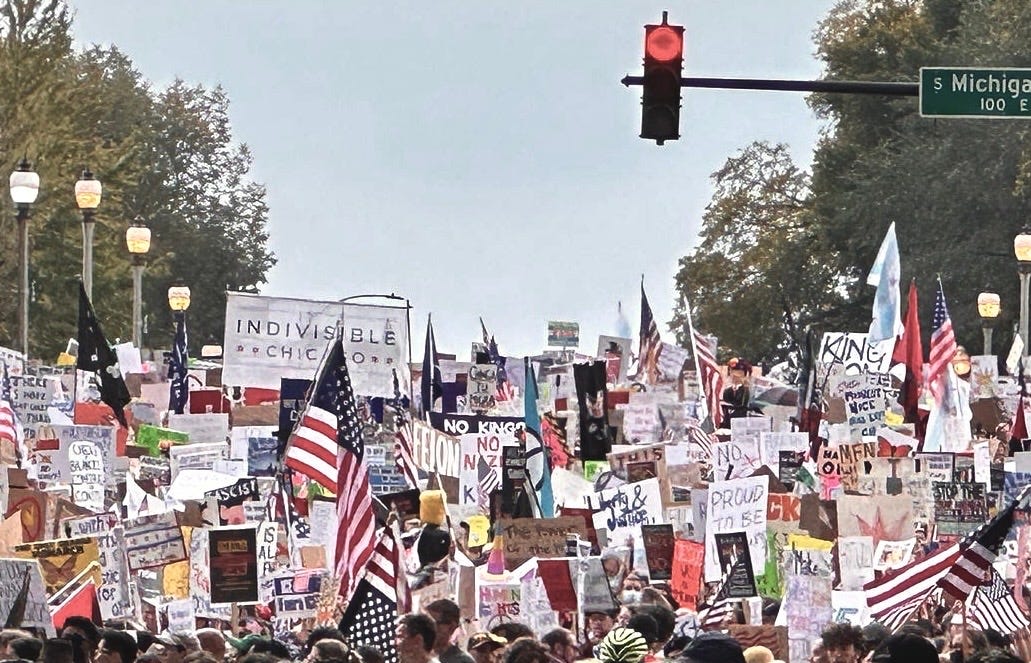
But First: The Protests and the Behavioral Lensing of It All
I responded to Anne Applebaum’s “Will the Beacon Go Dark?” — her essay on how American democracy is fracturing from within. She traces how institutions once built to defend freedom abroad now struggle to maintain it at home. Her warning: the world no longer watches America with admiration, but with alarm.
My response:
This is a moment that demands clarity.
Millions marched peacefully. The president responded with a crown and a digital smear campaign…literally defecating on dissent. That’s not satire. That’s contempt for the Constitution.
Democracy was never just an export. It was our internal scaffolding. And now, as that scaffolding buckles, the world watches…not with admiration, but with alarm.
But here’s the deeper behavioral truth: people marched, but the system didn’t flinch.
Russia once allowed protest too. It was tolerated, even theatrical. And then, slowly, it wasn’t. The state didn’t crush protest overnight. It made it irrelevant. It let people march, chant, post, and then quietly ensured none of it changed anything.
We’ve seen this in Turkey. In Venezuela. Mass protests filled the streets until governments learned to let them happen, then quietly strip them of consequence. The state didn’t ban dissent. It metabolized it.
That’s the danger in the U.S. now. Not that protest is banned, but that it’s absorbed. The system lets you march, chant, post…and then scrolls past. It offers the illusion of participation while insulating itself from impact. That’s not democracy. That’s performance management.
If we don’t build structures that convert visibility into leverage, if we don’t organize beyond the spectacle, then we’re not resisting authoritarian drift. We’re rehearsing it.
This isn’t a call to despair. It’s a call to strategy.
We’re now living in a split-screen reality. On one side, millions are marching. On the other, the official record barely registers it. That gap isn’t accidental, it’s engineered. And it’s a core tactic of authoritarian drift: make the resistance look nearly invisible so the public assumes it doesn’t exist.
This Week’s Stories
My Series: The Collapse of Moral Authority
Part III: The Economic Fallout—When Unpredictability Becomes Policy
This installment has gotten significant attention. The entire series is now available in my Posts Section.
The core argument: For decades, the United States offered the global economy something more valuable than military might, predictability. Allied nations could plan investments, negotiate treaties, and build supply chains around stable expectations about American behavior. The U.S. was predictable to its friends and unpredictable to its adversaries; a strategic asymmetry that formed the bedrock of the liberal international order.
From a behavioral perspective, this moment is clarifying. Systems under stress reveal their true incentive structures. What we’re learning is that the liberal international order was never as robust as it appeared. It depended on American willingness to bear disproportionate costs for systemic stability, and on the belief that America would remain predictably committed to that role. Both assumptions have failed.
The reconfiguration will be painful, expensive, and prolonged. But it’s also irreversible. The trust that’s been squandered cannot be quickly rebuilt. The institutions that are fracturing cannot be easily repaired. The alternatives that are emerging will not simply dissolve when American leadership is restored…if it ever is.
We’re not experiencing a crisis that will pass. We’re living through a phase transition in the global economic order. The collapse of moral authority isn’t just a diplomatic problem or a values crisis. It’s an economic catastrophe whose costs are only beginning to be calculated.
Joyce Vance: John Bolton
Vance analyzes the politicization of justice and the erosion of prosecutorial integrity.
My response: The final line, “the damage will take years to repair,” feels like a comforting fiction.
From a behavioral lens, once institutional trust is breached at this depth, where prosecutorial integrity is openly politicized and selective justice becomes routine, the damage isn’t just temporal. It’s structural.
The public begins to internalize the idea that law is no longer a neutral framework, but a weapon wielded by whoever holds power. That shift doesn’t just erode faith in the system. It rewires how people engage with it.
Institutions don’t recover by default. They recover only when the public demands accountability with clarity and consistency—-not just for the enemies of power, but for its friends.
MeidasTouch: No Kings Is More Than a Slogan
An examination of how authoritarianism relies on public fatigue and the normalization of chaos.
My response: The metaphor of an abusive relationship isn’t just apt, it’s behavioral truth. Systems don’t collapse all at once; they erode through denial, deflection, and the slow normalization of harm.
Fatigue is the fuel of authoritarianism. Trump doesn’t need loyalty. He needs distraction, despair, and the quiet resignation that comes when people confuse catharsis with change. That’s the genius of the chaos machine: it overwhelms the public until outrage becomes ambient noise.
Democracy isn’t self-cleaning. It doesn’t respond to hashtags, it responds to sustained, organized, behavioral pressure. And if we do not convert spectacle into structure, we’re not resisting. We’re rehearsing.
The real protest starts the day after.
Michael McFaul: The Case for Renewed Liberal Internationalism
McFaul makes a compelling argument against the premature abandonment of liberal internationalism and American global leadership.
My response: What you’ve articulated here, the premature funeral for American global leadership, is not just a geopolitical concern. It’s a behavioral one. When elites begin to treat disengagement as destiny, they stop building the scaffolding required for renewal.
That’s why I increasingly see Europe as the moral ballast in a drifting world. Not because it’s perfect, but because it still carries the memory of what happens when pluralism collapses. If the U.S. continues to wither into isolationism, Europe may become the last institutional architecture capable of defending liberal values at scale.
The moral center of gravity is shifting…and Europe may be the only one capable of carrying it forward.
Stay Tuned with Preet: So You’ve Decided to Target Random Americans
An analysis of the normalization of extrajudicial violence and the militarization of domestic policy.
My response: This is not national security. It is a blueprint for domestic warfare.
Military strikes in the Caribbean. Deployments in American cities. A Secretary of Defense discarding rules of engagement. An Attorney General equating political dissent with cartel violence.
From a behavioral lens, this is not escalation by accident. It is escalation by design.
I saw these patterns firsthand working inside government. The distortion of legal frameworks. The quiet normalization of lethal force. The rebranding of ideology as terrorism. These are not theoretical concerns. They are operational shifts in a country that has long been unjust and is now becoming openly dangerous.
When the executive branch claims the authority to kill without trial, without evidence, without oversight, the question is no longer whether the United States is democratic. The question is whether it remains lawful.
Adam Kinzinger: The GOP’s Young Leaders Aren’t Kids
Kinzinger examines how tribal loyalty within the Republican Party overrides moral accountability.
My response: This is a textbook case of tribal insulation overriding moral clarity.
From a behavioral lens, the refusal to condemn racism within one’s own ranks isn’t just hypocrisy, it’s strategic. It signals that loyalty to the group outweighs accountability to principle. When identity becomes more important than integrity, the group begins to protect its worst impulses.
I’ve written before about how institutions normalize harm through silence and delay. This is that pattern in miniature.
That’s how cruelty becomes procedural.
The Through Line
Institutions don’t recover by default. They recover only when the public demands accountability with clarity and consistency…not just for the enemies of power, but for its friends. Without that, what we call “repair” is just reputational patchwork over a hollowed-out foundation.
We’ve spent too long defending democracy like it’s a museum exhibit: fragile, historic, untouchable. But democracy isn’t preservation. It’s construction. If people don’t see it improving their lives, they won’t fight to keep it.
The next chapter isn’t about saving the system. It’s about rebuilding it.
We’re not in a moment that requires patience. We’re in a moment that requires reckoning.
Why the Snail
It carries its home.
It moves with intention.
It leaves a trail.
So do I.
Send Pass this forward
Subscribe Get clarity biweekly
— Johan
Professor of Behavioral Economics & Applied Cognitive Theory
Former Foreign Service Officer
“But here’s the deeper behavioral truth: people marched, but the system didn’t flinch.”
Another example for this is the Hong Kong protest during the pandemic. However, yes I agree with you that this is a call for strategy, not despair. To give up is to admit defeat. I guess we need to start a conversation on what else citizens can do outside mass protests?